
SEO vs AEO vs GEO: What’s the Difference and Why It Matters?

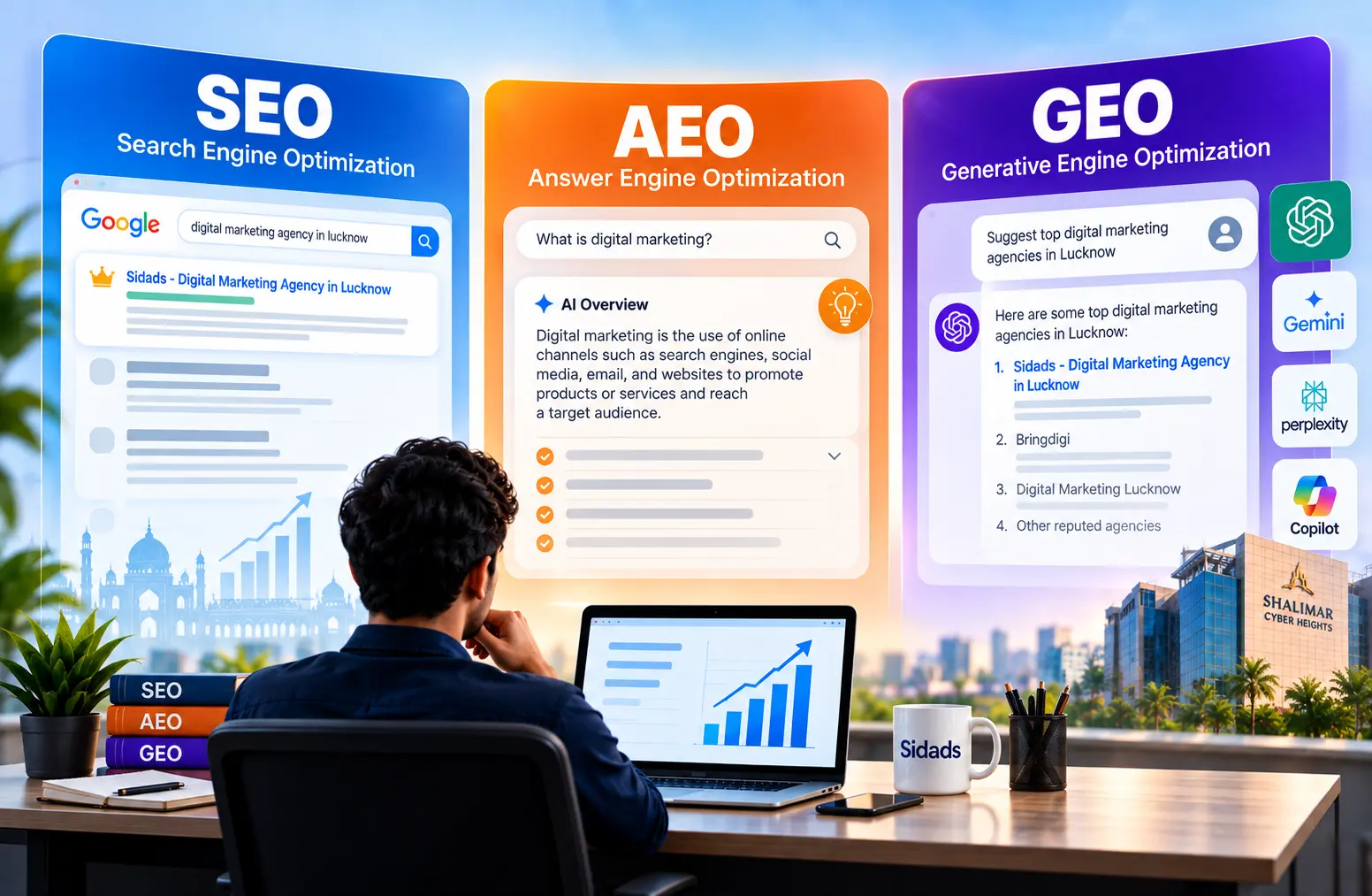
Search is changing rapidly. People no longer use search engines only to find a list of websites. Today, users expect quick answers, conversational results, recommendations, and information directly from search engines and AI platforms.
This shift has introduced three important digital marketing concepts: SEO, AEO, and GEO.
While these strategies have different objectives, they work together to improve a brand’s online visibility. Understanding the difference between SEO, AEO, and GEO can help businesses create content that reaches users across traditional search engines and AI-powered platforms.
What Is SEO?
SEO stands for Search Engine Optimization. It is the process of improving a website and its content so that search engines can understand, index, and rank it for relevant searches.
Traditional SEO focuses heavily on visibility in search engine results pages (SERPs). It includes activities such as keyword research, technical SEO, content optimization, internal linking, website speed optimization, backlinks, mobile optimization, and improving user experience.
For example, if someone searches for “best digital marketing agency in Lucknow,” an SEO strategy aims to help a relevant website appear prominently in the search results.
The main goal of SEO is:
Improve website visibility → attract relevant traffic → generate leads and conversions.
What Is AEO?
AEO stands for Answer Engine Optimization. Instead of focusing only on ranking a webpage, AEO focuses on providing clear and direct answers to questions users ask.
Search engines and answer-focused platforms increasingly provide information directly in search results. Users may search questions such as:
- What is SEO?
- How much does website development cost?
- Which platform is better for an online store?
- How does Google Ads work?
AEO helps content become easier for search systems to understand and potentially use when generating answers.
A strong AEO strategy usually includes clear questions and answers, concise explanations, structured headings, FAQs, lists, definitions, and well-organized information.
The goal is simple:
Understand the question → provide a useful answer → make the information easy to extract and understand.
What Is GEO?
GEO stands for Generative Engine Optimization. It focuses on improving a brand’s visibility and representation in AI-generated search experiences.
Platforms powered by generative AI can synthesize information from multiple sources and provide conversational responses instead of displaying only traditional blue links.
GEO therefore focuses on creating authoritative, useful, well-structured content that AI systems can understand and potentially reference when answering relevant queries.
For example, a user might ask an AI search platform:
“What are some custom software development companies in Lucknow?”
A GEO-focused content strategy aims to make a company’s information clear, trustworthy, specific, and easy for AI systems to interpret.
SEO vs AEO vs GEO: Key Difference
The simplest way to understand the difference is to look at what each strategy is designed to achieve.
SEO: Optimizes content and websites for search engine visibility.
AEO: Optimizes content to answer users’ questions clearly and directly.
GEO: Optimizes information and content for AI-powered and generative search experiences.
These strategies are not replacements for one another. In many cases, they complement each other.
Why Businesses Need SEO, AEO and GEO
A business today may be discovered through a Google search, a featured answer, a voice search, an AI chatbot, or an AI-generated search result.
That means simply publishing blog posts is no longer enough.
Businesses should create content that is:
- Helpful and original
- Easy to understand
- Well structured
- Based on real expertise
- Supported by relevant information
- Optimized around user intent
- Easy for search engines and AI systems to interpret
For example, instead of writing an article only around the keyword “website development company,” a business can build a complete content cluster covering website development costs, WordPress vs custom development, website development process, common mistakes, FAQs, and industry-specific solutions.
This approach supports traditional SEO while also creating useful information for answer and generative search experiences.
How to Create an SEO, AEO and GEO-Friendly Blog
Start with the user’s search intent rather than simply inserting keywords.
Use one clear H1 heading, logical H2 and H3 headings, short paragraphs, descriptive subheadings, lists, tables where useful, and FAQs.
Answer important questions directly. Avoid unnecessary filler and provide specific information that demonstrates expertise.
Use internal links to relevant pages and maintain consistent business information across your website and other authoritative platforms.
Most importantly, write for humans first. Search engines and AI systems are becoming better at understanding context, meaning, expertise, and usefulness.
SEO, AEO and GEO Work Together
The future of search is not necessarily about choosing SEO vs AEO vs GEO. A strong digital strategy can use all three.
SEO helps people discover your website through traditional search. AEO helps your content answer questions clearly. GEO helps your information become more useful within emerging AI-driven search experiences.
Businesses that combine these approaches can build a stronger and more adaptable content strategy as the way people search continues to evolve.




Pingback: How Much Does Digital Marketing Cost in India? - Sidads