Logo Design vs Brand Identity: What’s the Difference and Why Does Your Business Need Both?


When starting a business, one of the first things many business owners think about is getting a logo designed. A professional logo is important, but a logo alone is not a complete brand identity.
Your logo is one part of how people recognize your business. Brand identity is the complete visual and communication system that tells people who you are, what you stand for, and what they can expect from your business.
So, what is the difference between logo design and brand identity? Why does your business need both? And how can you build a strong identity that works across your website, social media, packaging, advertising, and other customer touchpoints?
Let’s understand it in simple terms.
What Is Logo Design?
Logo design is the process of creating a visual mark that represents a business, brand, product, or organization.
A good logo helps customers recognize your business quickly. It can be a wordmark, symbol, combination mark, lettermark, emblem, or another distinctive visual form. The main purpose of a logo is recognition.
A professional logo should ideally be:
Simple → Memorable → Relevant → Scalable → Versatile → Distinctive
For example, your logo may appear on your website, business cards, packaging, advertisements, social media profiles, invoices, signage, and product materials. However, a logo cannot communicate everything about your business by itself. It needs a broader visual and communication system around it.
What Is Brand Identity?
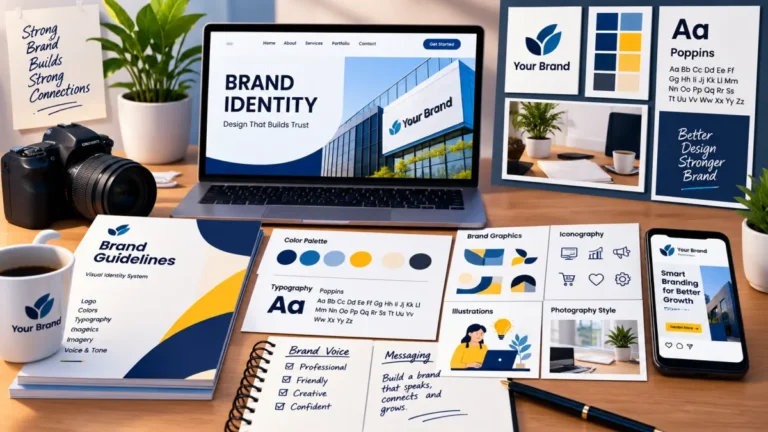
Brand identity is the complete collection of visual and verbal elements that a business uses to present itself consistently.
It answers an important question:
“How should people recognize and experience this brand?”
A complete brand identity can include:
Logo → Color Palette → Typography → Brand Graphics → Photography Style → Iconography → Illustrations → Brand Voice → Messaging → Packaging → Business Stationery → Social Media Templates → Website Design → Brand Guidelines
This means brand identity goes far beyond creating a logo. It creates a consistent experience across different platforms and customer interactions.
Logo Design vs Brand Identity: The Key Difference
The simplest way to understand the difference is:
Logo = One visual symbol of your business
Brand Identity = The complete system used to visually and verbally represent your business
Think of your logo as the face of your business, while brand identity is the complete appearance, personality, communication style, and experience of the brand.
For example, imagine a clothing company. Its logo may be a simple wordmark.
But its complete brand identity could include:
Logo → Colors → Fonts → Packaging → Photography → Website → Social Media → Advertising → Brand Voice → Customer Communication
The logo identifies the company, while the brand identity creates a consistent experience around it.
What Does a Logo Include?
A professional logo design project may involve several important decisions.
Logo Concept
The first step is understanding the business, audience, positioning, and visual direction.
Business Offering → Target Customers → Customer Problem → Business Difference → Business Goals → Target Market
Logo Style
Depending on the business, the logo can be:
Wordmark → Lettermark → Symbol → Combination Mark → Emblem → Abstract Mark
Logo Variations
A professional logo should work across different applications.
Primary Logo → Secondary Logo → Icon/Mark → Horizontal Version → Vertical Version → Monochrome Version → Light Version → Dark Version
This helps the logo remain usable on websites, packaging, social media, print materials, and different backgrounds.
What Does Brand Identity Include?
Brand identity creates the broader visual language of a business.
1. Logo
The logo acts as the primary recognition element.
Logo → Logo Variations → Logo Placement → Clear Space → Minimum Size → Usage Rules
2. Color Palette
Colors influence how customers perceive a brand and help create visual consistency. A complete palette may include:
Primary Colors → Secondary Colors → Accent Colors → Background Colors → Neutral Colors
For example, a premium brand may use refined neutral tones, while a modern technology brand may use stronger digital colors.
3. Typography
Typography determines how written communication looks across different brand touchpoints. A typography system can include:
Main Headings → Subheadings → Body Content → Buttons → Promotional Materials → Social Media Graphics. Using consistent typography makes a brand easier to recognize.
4. Brand Graphics
Brand graphics are supporting visual elements that make the identity more distinctive. These can include:
Shapes → Patterns → Lines → Textures → Frames → Background Elements → Graphic Motifs
5. Photography Style
Photography also contributes to brand recognition. A photography direction may define:
Image Composition → Lighting → Background Style → Subject Positioning → Color Treatment → Image Mood → Product Photography Style
This becomes particularly important for e-commerce, fashion, hospitality, food, real estate, and lifestyle brands.
6. Iconography and Illustrations
Icons and illustrations can create a consistent visual language across websites, applications, presentations, and marketing materials. The system may include:
Icons → Illustrations → Shapes → Patterns → Supporting Graphics → Image Treatments
7. Brand Voice
Brand identity is not only visual. The way a business communicates also matters.
A brand voice can be:
Professional → Friendly → Conversational → Premium → Educational → Bold → Minimal → Approachable
The important thing is consistency.
8. Brand Messaging
Messaging explains what the brand wants customers to understand and remember. A messaging framework can include:
Tagline → Value Proposition → Brand Promise → Key Messages → Product Messaging → About-Us Messaging → Campaign Messaging
Why Does Your Business Need Both?
A logo and brand identity serve different purposes, but they work best together.
1. A Logo Creates Recognition
A strong logo helps customers identify your business quickly. When people repeatedly see the same visual mark across different platforms, it can become associated with your business.
2. Brand Identity Creates Consistency
Imagine a business using a different color on every social media post, different fonts on its website, and completely different imagery in advertisements. Even if the logo is excellent, the overall brand can feel inconsistent. Brand identity creates consistency across:
Website → Social Media → Packaging → Print → Signage → Advertisements → Mobile Applications
3. It Builds a Professional Appearance
Customers often form an initial impression from how a business presents itself visually. A consistent identity can help a business communicate professionalism through:
Logo → Colors → Fonts → Photography → Graphics → Messaging
4. It Helps Differentiate Your Business
Many businesses offer similar products or services. A distinctive brand identity can help create a recognizable visual presence. Differentiation can come from:
Color System → Typography → Visual Style → Photography → Graphic Language → Brand Voice → Messaging
5. It Makes Marketing Easier
Once your brand identity is established, creating marketing materials becomes more structured. Instead of deciding the visual style from scratch for every campaign, your team can follow established guidelines.
This can cover:
Social Media Posts → Google Ads → Meta Ads → Website Banners → Brochures → Email Marketing → Presentations → Packaging → Promotional Materials
Logo Design vs Brand Identity: Quick Comparison
| Logo Design | Brand Identity |
|---|---|
| Creates a recognizable mark | Creates the complete brand system |
| Primarily visual | Visual + verbal |
| Focuses on recognition | Focuses on consistency and experience |
| One important brand asset | Collection of interconnected assets |
| Usually one project deliverable | Can include multiple design systems |
| Used across brand touchpoints | Defines how all touchpoints should look and communicate |
The two should not be treated as competing options.
Logo Design + Brand Identity = Stronger Brand Presence
When Should a Business Invest in Brand Identity?
A complete brand identity can be particularly useful when:
Launching a New Business → Rebranding an Existing Business → Entering a New Market → Launching New Products → Expanding Online → Building an E-commerce Brand → Growing a Franchise → Professionalizing Marketing Materials
For a very small business, starting with a professional logo and basic visual system may be enough initially. As the business grows, a more comprehensive identity system can be developed.
Common Mistakes Businesses Make
One of the biggest mistakes is treating the logo as the entire brand. Other common problems include:
Changing Brand Colors Frequently → Using Too Many Fonts → Inconsistent Social Media Designs → Random Photography Styles → Inconsistent Logo Usage → No Brand Guidelines → Different Communication Styles → Copying Competitors
A successful identity does not necessarily need to be complicated. It needs to be consistent, relevant, recognizable, and aligned with the business.
How Much Does Logo and Brand Identity Design Cost in India?
The cost depends on the scope of work, number of concepts, research, design complexity, revisions, and deliverables. A basic logo project may include:
Logo Concept → Logo Variations → Basic Color Palette → Basic Typography
A more complete brand identity project may include:
Brand Strategy → Professional Logo → Color Palette → Typography System → Brand Graphics → Photography Direction → Iconography → Brand Messaging → Social Media Templates → Website Design Direction → Brand Guidelines
Therefore, branding costs can vary significantly depending on the requirements of the business. Instead of choosing a package based only on price, businesses should consider the actual deliverables they need.
Frequently Asked Questions
Is a logo the same as a brand identity?
No. A logo is one element of a brand identity. Brand identity includes the logo along with colors, typography, graphics, imagery, messaging, brand voice, and other visual and communication elements.
Can I have a good brand without a professional logo?
A recognizable logo is an important part of a professional brand identity. However, the overall brand experience depends on more than the logo.
Which should I create first: logo or brand identity?
The logo is usually developed as part of the broader identity process. Ideally, the business should first understand its positioning, audience, personality, and visual direction before finalizing the logo.
Why are brand guidelines important?
Brand guidelines explain how the identity should be used consistently. They may cover:
Logo Variations → Minimum Logo Size → Clear Space → Color Codes → Typography → Image Style → Icon Style → Graphic Elements → Social Media Guidelines → Tone of Voice → Logo Usage Restrictions
Is brand identity important for small businesses?
Yes. Small businesses also interact with customers across multiple touchpoints. A consistent identity can help create a professional and recognizable presence.
Final Thoughts
A logo is an important starting point, but it is only one piece of the branding puzzle. Your logo helps people recognize your business. Your brand identity helps them understand, remember, and experience it consistently. A complete brand identity brings together:
Logo → Colors → Typography → Graphics → Photography → Iconography → Illustrations → Brand Voice → Messaging → Guidelines
When these elements work together, your business can create a more consistent presence across its website, social media, packaging, advertising, and other customer touchpoints.
In simple terms:
Logo Design creates recognition.
Brand Identity creates consistency.
Together, they create a stronger and more recognizable brand experience.