E-Commerce Website Development: Complete Guide to Building an Online Store


Online shopping has become a normal part of everyday life. Customers now expect to discover products, compare prices, read reviews, make payments, and track their orders without visiting a physical store. For businesses, this has created a huge opportunity to reach customers beyond their local market.
But building an online store is not simply about putting products on a website. A successful e-commerce website needs thoughtful design, easy navigation, secure payments, fast performance, mobile responsiveness, search engine optimization, and a smooth checkout experience.
E-commerce website development is the process of planning, designing, developing, and maintaining an online store where businesses can showcase their products or services and customers can purchase them online.
In this guide, we will explain what e-commerce development means, how the development process works, which features an online store needs, and how businesses can create an e-commerce website that is ready for long-term growth.
What Is E-Commerce Website Development?
E-commerce website development refers to the creation of an online store that allows businesses to sell products or services through the internet.
A typical e-commerce website allows customers to:
- Browse products and categories
- Search for specific products
- View product details and images
- Select sizes, colors, or other variants
- Add products to a shopping cart
- Make online payments
- Place and track orders
- Create customer accounts
- Contact the business for support
Behind the customer-facing website, businesses also need an administration system to manage products, inventory, orders, customers, discounts, payments, and other operations.
Depending on the business requirements, an online store can be developed using platforms such as Shopify, WooCommerce, Magento, or custom e-commerce development.
Why Is an E-Commerce Website Important for a Business?
A physical store has limitations. It operates within a particular location and usually has fixed opening hours. An online store can make products available to customers throughout the day.
An e-commerce website can help businesses:
- Reach customers across different cities and regions
- Sell products 24/7
- Build a strong online presence
- Accept digital payments
- Manage orders from one place
- Promote products through digital marketing
- Generate sales directly from the website
- Understand customer shopping behavior
- Expand the business over time
For small businesses and growing brands, an e-commerce website can also provide a direct digital channel between the brand and its customers.
What Features Should an E-Commerce Website Have?
A professional e-commerce website should make shopping simple from the first visit to the final order.
1. Mobile-Friendly Design
Many customers browse and shop using smartphones. That makes responsive design an essential part of e-commerce website development.
The website should work smoothly on:
- Mobile phones
- Tablets
- Laptops
- Desktop computers
Product images, menus, buttons, forms, and checkout pages should remain easy to use on smaller screens.
2. Easy Product Navigation
Customers should be able to find what they are looking for without getting confused.
A well-organized store usually has clear product categories, subcategories, filters, and search functionality.
For example, a fashion store might organize products into:
Men → T-Shirts → Oversized T-Shirts
This type of structure improves the shopping experience and also creates a logical website structure for SEO.
3. Detailed Product Pages
The product page is where customers decide whether they want to purchase an item.
A good product page should include:
- Product name
- High-quality images
- Product description
- Price
- Available variants
- Size information
- Product specifications
- Availability
- Shipping information
- Return information
- Customer reviews
The content should answer the questions a customer is likely to have before purchasing.
4. Product Search and Filters
Large online stores can have hundreds or thousands of products. Without effective search and filtering, customers may struggle to find the right item.
Useful filters can include:
- Price
- Brand
- Size
- Color
- Category
- Rating
- Availability
A simple search experience can make a significant difference to how customers interact with an online store.
5. Shopping Cart
The shopping cart gives customers an opportunity to review their selected products before placing an order.
It should allow users to:
- Increase or decrease quantities
- Remove products
- Apply coupons
- Check shipping charges
- View the total price
- Continue shopping
- Proceed to checkout
The process should be clear and free from unnecessary steps.
6. Secure Checkout and Payment
Checkout is one of the most important stages of an e-commerce website.
Customers should be able to enter their information, select a delivery method, choose a payment option, and complete their order without unnecessary complexity.
Depending on the target market, businesses can offer payment methods such as:
- UPI
- Credit cards
- Debit cards
- Net banking
- Digital wallets
- Cash on delivery
Payment gateways should be properly integrated and securely configured.
How Does E-Commerce Website Development Work?
Building an online store normally involves several stages.
Step 1: Understanding the Business
Before development begins, the business requirements need to be understood.
This includes identifying:
- Products or services
- Target customers
- Competitors
- Business model
- Sales channels
- Required integrations
- Marketing goals
- Budget and scalability requirements
This initial planning helps determine which platform and features are appropriate.
Step 2: Planning the Website Structure
The next step is to create the website structure.
Common pages include:
- Home
- Shop
- Product Categories
- Product Pages
- About Us
- Contact
- Cart
- Checkout
- My Account
- Shipping Policy
- Return Policy
- Privacy Policy
- Terms and Conditions
- Blog
A clear structure helps customers navigate the website and helps search engines understand the relationship between different pages.
Step 3: UI/UX Design
The website design should reflect the brand while keeping the shopping experience simple.
Good e-commerce UI/UX focuses on:
- Clear navigation
- Readable typography
- Strong product presentation
- Consistent branding
- Simple calls to action
- Easy checkout
- Mobile responsiveness
The goal is not just to create a beautiful website. The goal is to make shopping comfortable and intuitive.
Step 4: Website Development
Once the design is ready, developers build the functional website.
Depending on the selected platform, development can include:
- Product management
- Shopping cart
- Checkout
- Payment gateway
- Customer accounts
- Inventory management
- Shipping integration
- Coupon system
- Reviews
- Analytics
- Third-party integrations
Step 5: Product Upload
Products are then added to the website with accurate information.
Product data may include names, descriptions, prices, images, variants, SKUs, inventory, and shipping information.
For stores with large catalogs, bulk product import can save considerable time.
Step 6: Testing
Before launching an online store, every important function should be tested.
Testing should cover:
- Mobile responsiveness
- Product search
- Filters
- Cart functionality
- Checkout
- Payment gateway
- Coupon codes
- Forms
- Order notifications
- Website speed
- Browser compatibility
A website should ideally be tested on different devices before going live.
Step 7: Launch and Continuous Improvement
Launching the website is not the final step.
After launch, businesses should monitor website performance, customer behavior, search rankings, conversions, technical errors, and sales.
Regular improvements can help the website perform better as the business grows.
Shopify vs WooCommerce vs Custom E-Commerce Development
One of the most common questions businesses have is which platform they should choose.
Shopify
Shopify is a hosted e-commerce platform designed to make it easier to create and manage an online store.
It can be suitable for businesses that want a structured platform with hosting and many e-commerce features already available.
WooCommerce
WooCommerce is an e-commerce solution built for WordPress.
It provides flexibility and can be a practical option for businesses that already use WordPress or want greater control over their website.
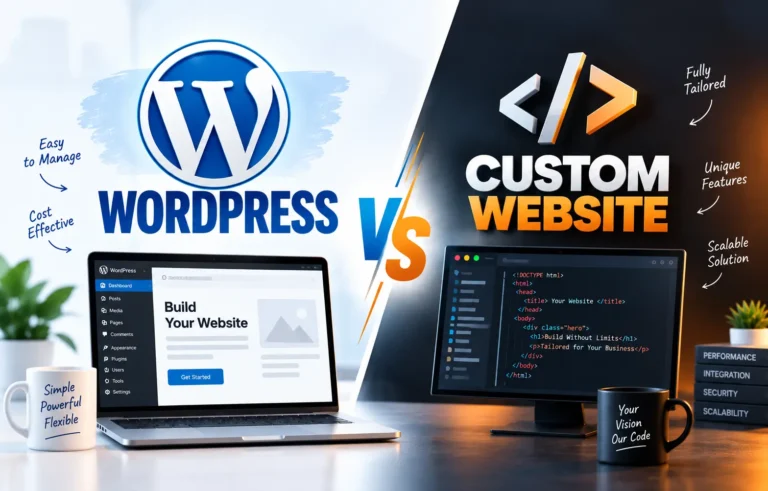
Custom E-Commerce Development
Custom development allows businesses to create functionality specifically around their requirements.
It can be useful when a business needs complex workflows, specialized integrations, unique customer experiences, or functionality that standard platforms cannot easily provide.
The right choice depends on the business model, budget, required features, technical requirements, and future plans.
How SEO Helps an E-Commerce Website Get Found
A well-designed online store is useful only when customers can find it.
E-commerce SEO focuses on improving the visibility of product, category, and informational pages in search engines.
Important areas include:
- Keyword research
- Product page optimization
- Category page optimization
- SEO-friendly URLs
- Internal linking
- Image optimization
- Product schema
- Meta titles and descriptions
- Technical SEO
- Mobile optimization
- Page speed
- Helpful content
For example, instead of writing a generic product description such as “High-quality shoes available in different sizes,” a useful product page should explain the product’s material, features, ideal use, available sizes, and other information customers actually need.
This creates useful content for both customers and search engines.
E-Commerce Website Speed and Security
Website performance has an important role in online shopping.
If a product page takes too long to load, customers may leave before viewing the product or completing checkout.
Businesses should pay attention to:
- Image compression
- Mobile performance
- Website hosting
- Caching
- Code optimization
- Third-party scripts
- Database performance
Security is equally important because e-commerce websites handle customer information and online transactions.
Using HTTPS, secure payment gateways, strong authentication, regular updates, backups, and appropriate security measures can help protect the website and its customers.
Benefits of Professional E-Commerce Development
A professionally developed e-commerce website can provide several benefits.
Better Customer Experience
Customers can browse products, compare options, and place orders through a convenient online interface.
Stronger Brand Identity
A dedicated website gives businesses greater control over their branding, content, product presentation, and customer experience.
Direct Sales Channel
Instead of depending completely on third-party marketplaces, businesses can create a direct sales channel through their own website.
Easier Marketing Integration
An online store can be connected with SEO, Google Ads, social media marketing, email marketing, WhatsApp marketing, analytics, and other digital channels.
Business Scalability
A properly planned e-commerce website can grow alongside the business by adding new products, categories, integrations, payment options, and features.
Frequently Asked Questions About E-Commerce Development
How much does it cost to develop an e-commerce website?
The cost depends on factors such as the platform, number of products, design requirements, custom functionality, integrations, payment gateway, shipping system, and development complexity. A basic online store and a large custom e-commerce platform can have very different development costs.
How long does it take to build an e-commerce website?
A simple store can often be developed faster than a custom e-commerce platform. The timeline depends on the number of pages, products, integrations, design requirements, and functionality involved.
Which is better for an e-commerce website: Shopify or WooCommerce?
Neither platform is universally suitable for every business. Shopify provides a hosted e-commerce environment, while WooCommerce provides an e-commerce solution within WordPress. The better option depends on the business’s requirements, technical preferences, budget, and future plans.
Can an e-commerce website be optimized for Google?
Yes. Product pages, category pages, technical structure, content, images, internal links, structured data, and website performance can all be optimized as part of an e-commerce SEO strategy.
Is mobile optimization necessary for an online store?
Yes. Customers increasingly use mobile devices for browsing and shopping, so an e-commerce website should provide a smooth experience across smartphones, tablets, and desktop devices.
Final Thoughts
E-commerce website development is not simply about creating an online catalog. It combines website design, technology, user experience, security, SEO, content, payments, and business strategy to create a complete digital shopping experience.
Whether you are launching a new online brand, taking an existing business online, or improving an existing store, the right development approach can create a strong foundation for future growth.
The most effective e-commerce websites focus on one simple objective: making it easy for the right customer to find the right product and complete a purchase with confidence.
By combining a user-friendly design with fast performance, secure payments, useful product information, SEO, AEO, and GEO-friendly content, businesses can build an online store that is useful not only for today’s customers but also for the changing digital search landscape.